

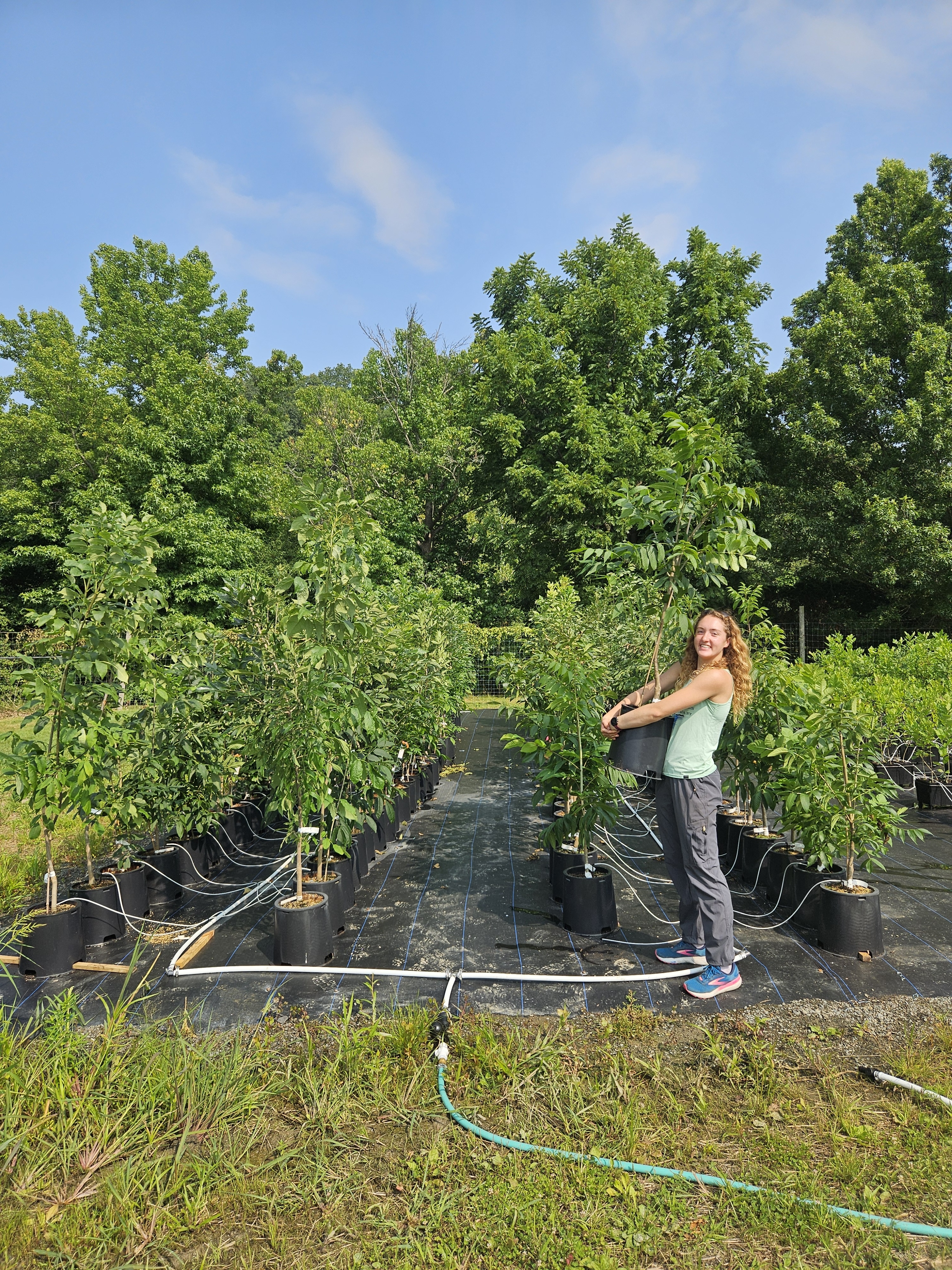
There are 8 billion Ash trees in North America, and we’re losing more than 99% of them due to infestation by an invasive insect, the Emerald Ash Borer. As the Learning by Leading summer intern with the gardens natural areas team, I’ve assisted with two Ash conservation efforts, which were my favorite parts of the summer.
The first effort I assisted with was to grow “Lingering Ash” trees to replant out into the forests. Lingering Ash are the survivors in an area where all of the other Ash trees have succumbed to Emerald Ash Borers. Cuttings from these trees are grown for two years and will be planted in the woods this fall! I helped up-pot and fertilize these trees, and collected leaf specimens from each tree to then send to a lab for genetic testing, to see if there’s a genetic difference between these resistant Ash and susceptible Ash.
The second effort I assisted with was treating Ash trees with insecticide. This is a time consuming, weather dependent process- the insecticide is pumped into trees around the base, and the trees take it up via their vascular system. Whenever I think something’s hard I remember carrying the Ash treatment kit through a wetland and stepping over trees felled to create more light for one of the gardens’ other conservation efforts, the American Globeflower. The kit is heavy, the walk was long, and my footing was both unsure and deep in mud, but knowing that this work was so critical for North America’s future forests pushed me through.
-Kyleigh Tangen '28
Learning by Leading Sustainable Landscapes Team Member