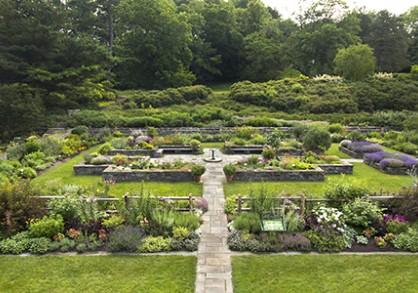
Visitors to the 2024 International Horticultural Exhibition in Chengdu, China, enjoyed a garden surprise courtesy of Chengdu Municipal Government and Cornell Botanic Gardens: a visit to the iconic Robison York State Herb Garden. Expo teams used original blueprints and current plant lists to create a full-scale replica of the garden to bring the curated herb collection and garden experience to the expo.
The re-creation of the Robison York State Herb Garden reflects and celebrates botanical and cultural diversity and promotes an exchange of horticultural knowledge between the U.S. and China. The project earned a Silver Award for International Gardens at the Expo.
The herb garden replica, which took six months to build, debuted on April 24, 2024, and remained on display until the Expo’s conclusion in October 2024. It was built to accurately show the Robison Herb Garden, one of the iconic spaces at Cornell Botanic Gardens on the Ithaca, New York, campus. The living facsimile includes many of the 500 varieties of herbs displayed in the Ithaca garden, raised beds constructed of stone, seating benches, and tidy grass peeking between walkway pavers.
“It was gratifying to see the quality and style of the original garden, as well as the interpretive messages, re-created with such care and attention to the original’s purpose and message,” said Christopher Dunn, executive director of Cornell Botanic Gardens. “If I show someone pictures of the replica of our herb garden, they are hard-pressed to tell the difference.”
The Robison York State Herb Garden was selected by the Expo because it displays a variety of plants with a range of practical uses and cultural values. Herbs are powerhouses of the plant world, with ornamental, culinary, and medicinal applications in our lives.
“Plants as an important element of nature, and symbols of life, are a manifestation of a connection to nature, and they offer feelings of peace, relaxation, and hope,” said Ying Hua, director of the Cornell China Center. “Gardens created with both natural and artificial elements also have special status in Chinese architecture and urban design. People draw spiritual sustenance from creating gardens and spending time in them.”
The replica offered visitors to the Expo insights into North American herb gardening practices, including knowledge of specific plants, benefits and uses, and the settings in which they thrive. It also raises awareness of Cornell Botanic Gardens on an international scale.
The project began when Dunn was considering how to generate interest in a planned Asian Summer Garden at Cornell Botanic Gardens, featuring East Asian plants and architectural forms. When he learned Chengdu would be hosting the International Association of Horticultural Producers (AIPH) 2024 International Horticultural Exhibition—touted as “the Olympics of horticulture—he saw the potential for collaboration with an international influence.
“It’s part of my effort to engage in what I call horticultural diplomacy: increasing awareness of other cultures through horticulture,” Dunn said.
An estimated 7.6 million guests visited the Expo, where displays like the Robison Herb Garden focused on sustainability, inclusion, and the aesthetic and practical significance of plants.
“In a world that is increasingly stressful, the regenerative and healing effect provided by gardens has been more and more recognized in both Eastern and Western cultures,” Hua said. “Going forward, in many different contexts, such as tourism and research, a lot of exchanges and collaborative work can be carried out to create more connections.”
Educational exchange is foundational to the Expo’s broader mission and that of Cornell Botanic Gardens. Projects such as the replica show people the vital role that plants play in preserving human cultural elements, such as language, food, and clothing.
“All cultures of the world depend on the plants in their region,” Dunn said. “You can’t have diversity of cultures without botanical diversity to support it. So maintaining this diversity is critically important for the survival of different cultures, their languages, and their traditional ways.”
Gina Nutt is an Ithaca, New York-based freelance writer.