


This thin-shell concrete structure, affectionately known as “The Hypar,” takes the shape of a hyperbolic paraboloid. When freed of its wooden supports and forms at its unveiling on June 2, 1966, a crowd of skeptics formed, expecting to witness the collapse of its gravity-defying 12 tons of concrete spanning 30 feet at only 2.5” thick. Of course, it stood strong that day, and ever since.
It was designed and built by the students of Cornell Architecture and Engineering Professor Don Greenberg's Architecture 233 course, Surface Structures. It is believed to have been the first-ever structure of its kind. The class project for the full semester was to design and build a shelter of thin-shell concrete at the entrance to the F. R. Newman Arboretum. A jury of Cornell faculty and administrators judged competing designs submitted by teams within the class, ultimately selecting the design submitted by engineer Bill Maxfield, CE '66, and architects Tom Zimmerman (Grad), and Buzz Lavine, Arch '67. Of the design, Lavine said he originally proposed a hyperbolic paraboloid because it was a “dynamic shape for us to be able to build.”
Engineering and Planning
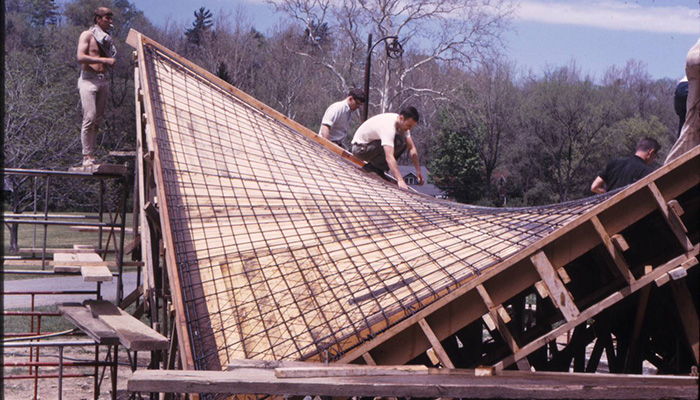
Having chosen a design, the class was broken into groups to plan and build the hypar. Groups were put in charge of foundations, building forms, structural design, materials and equipment, surveying, and the budget. Besides money, the biggest constriction facing them was time—only six weeks were available for the entire project.
Before any other work could be done, they had to completely analyze the shell surface by solving complex equations for its exact shape so that wooden forms could be built accurate to one-eighth inch at each point of the surface. Taking the extreme (for 1966) step of employing a computer, they had to analyze the stresses caused by its own weight so that the proper shell thickness and required amount of steel reinforcing could be determined for this curved, non-symmetric shape.
A hyperbolic paraboloid was a particularly desirable form for this project because the structure gains astounding strength and rigidity from its “double curvature,” meaning that the structure takes the form of a complex cable and arch system: conceptually, an infinite number of cables run lengthwise and an infinite number of arches run crosswise, like suspension bridges and Roman arches. Thus, it is not the brute strength of reinforced concrete which holds up the shell surface, but rather a subtle archcable suspension system.
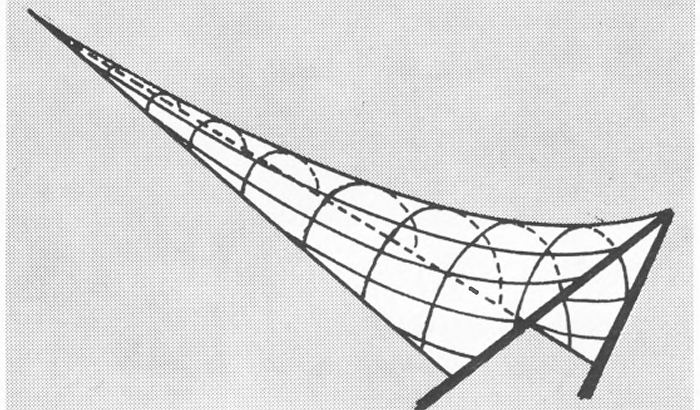
Also of great use, the hypar shape permitted construction with many straight steel reinforcing bars (each 3/8” thick), because from every point on the edge of the surface, there is one absolutely straight line running to another point on the opposite edge.
As to site selection, the arboretum offered Cornell-owned open space, where “what today is part of the fields of the … arboretum,” Buzz Lavine recalled, “back then was a grazing field for cattle ... only 150 feet away from the hypar itself.”
Construction
“The 14 students in the class built 16 framework panels [in the basement of Sibley Hall] and took them to the site,” said Professor Greenberg. The four along the center were unique, while on either side ran six pairs of symmetric right and left handed panels. Forms for each panel were made beforehand out of 2x4's and planking. Each panel was a hypar itself so all the boards had to be nailed in a warped position. This was probably the first use of this construction technique. As architect Buzz Lavine observed, “on the underside of the concrete structure you [can] still see all of the formwork boards, or the grain from them anyway, after the formwork was taken down.”
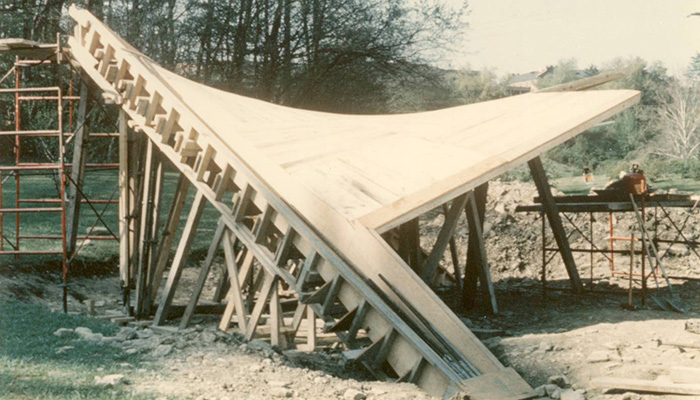
The first parts constructed were the footings. The shell was originally designed to have four legs— two on either side. However, a structural analysis showed that one leg on each side was providing little in the way of support. "So the class took them out and that's why you see only one leg on each side now," Greenberg said at the time. The two legs that remain are anchored by an underground “foundation that ... enables this structure that splays out down two beams to the ground, not to keep spreading out over time,” Lavine explained.
Several factors entered into the actual construction plans. Time was a severe limitation, since most of the work had to be done at night because of class schedules. Many of the students put in 100 hours of labor during the last two weeks of construction alone, working “pretty close to full time,” Lavine recalled. And since they owned no equipment themselves, the class had to coordinate the use of borrowed equipment.
The second phase began with the formwork for the two beams. It was built, held in position with shoring, and surveyed for precise alignment. Next, the 16 panels were sequentially clamped to the beams. The shell itself was poured and finished in five hours. A concrete mixture containing specially ordered hard sand and hard limestone was used on the surface. The concrete was dumped into mortar boxes and lifted to the shell by means of ropes, pulleys, and buckets.
Unveiling and Beyond
After the pouring and finishing had been completed, the class covered the shell with burlap and set a sprinkler at its center as the period of curing began. After seven days they turned off the sprinkler and took down the forms. As they did, a crowd of skeptics—many Civil Engineering students and some faculty—stood by to witness what they anticipated to be the imminent collapse of the hypar, convinced that its great weight could not be sustained by only two legs and a 2.5” shell thickness. “There was quite a crowd around to watch it fall, and it didn’t,” Lavine recalled.
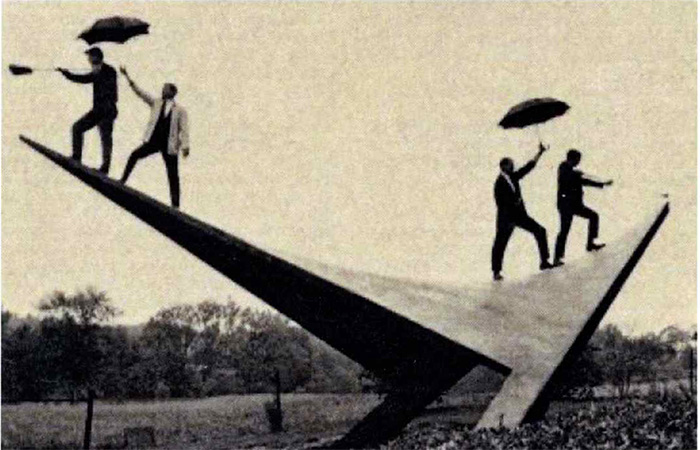
"Things went pretty slow at the start," Tom Zimmerman said. "We were a little apprehensive taking down the first three panels. But when we realized that it wasn't going anywhere, we just started knocking everything down. And it stood perfectly.” There was no measurable deflection in its surface; in fact, the class felt so confident of it that all fourteen climbed on for a toast and a picture.
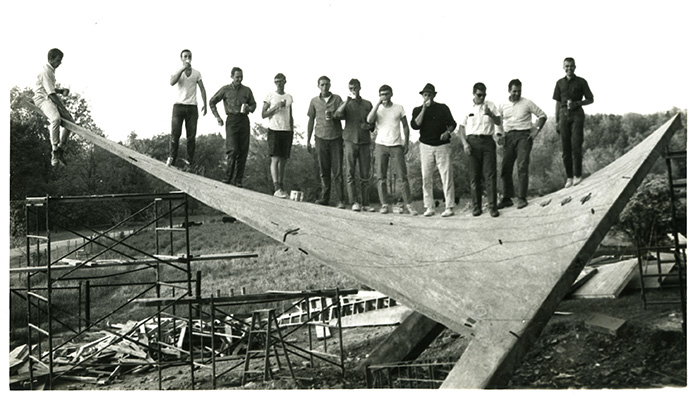
One iconic photo from the unveiling—below—was carried by the Associated Press and made its way far and wide, picturing the original design team and Professor Greenberg dressed in suits, umbrellas in hand for visual effect, standing high on the hypar in a strange but wonderful show of 1960’s aesthetic.
This account was written by Ari Levine
Information sourced from the "Cornell Engineer" Nov. 1966 and "Cornell Alumni Reports", Nov. 1966


More art in the Arboretum

Created by two Cornell graduates, "Lightwave" is a sculptural bench located near the ponds in the F. R. Newman Arboretum.

These abstract, ten-ton concrete sculptures were created in the 1960s by Cornell undergraduate architecture students.

The Garden of Stones symbolize the tenacity of life, honoring those who died in the Holocaust and those who survived.