I have always loved standing in a forest, listening to the wind rustle leaves while plants reach up towards the sun. Learning the names of trees and their history has deepened that beauty for me. And then, when I learned about all the invasive plants found beneath the forest floor, my understanding of the ecosystem changed once again. As the natural areas intern this summer, I became quite familiar with one invasive in particular, Pale Swallow-wort (Cynanchum rossicum).
While many invasive species are accidentally transported across oceans, Pale Swallow-wort was intentionally brought to North America as an ornamental plant in the 1800s. It has since become quite invasive and creates a monoculture in shady and sunny areas where it out competes native plants. Additionally, as a member of the same family as milkweed, it attracts Monarch butterflies (Danaus plexippus). However, the Monarch eggs are not able to complete their lifecycle on Swallow-wort, leaving the eggs to die.
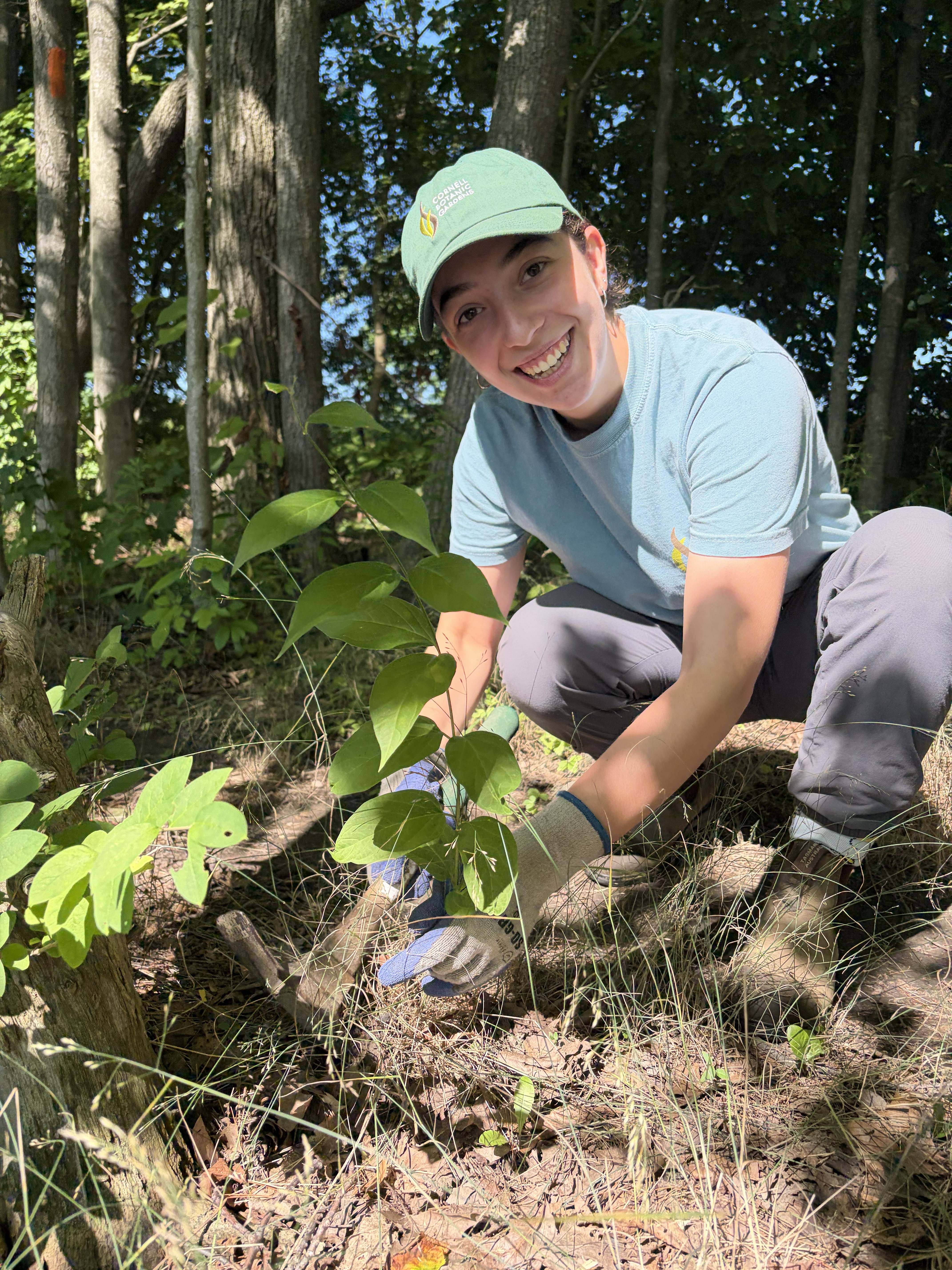
Pale Swallow-wort is found in many of Cornell Botanic Gardens’ Natural Areas. If one attempted to pull it straight from the ground, they would not pull out the white roots, letting the plant come back the following year. Instead, the stewardship crew and I hand dig each plant out of the ground. It is imperative to dig out the rhizome, where new stems grow from. Sometimes we see evidence of last year's stem. The process of hand digging, though slow and tedious, is very rewarding. When I enter areas that used to be covered in Swallow-wort that now only have only a handful of plants, I notice the loss of the ornamental beauty, but I prefer the native plants and am glad to work towards restoring the forest to the diverse ecosystem it’s meant to be.