Visitors to Cornell Botanic Gardens can now experience the beauty and cultural richness of the gardens, arboretum, and natural areas in more languages. Cornell Botanic Gardens has expanded its self-guided walking tours to Spanish and Mandarin to bring understanding of plants and cultures to broader audiences.
The self-guided tours help visitors explore the living landscapes of Cornell University through immersive walking experiences within Cornell Botanic Gardens’ cultivated gardens, arboretum, gorges, and other natural spaces, all of which define the iconic natural beauty of the Cornell campus.
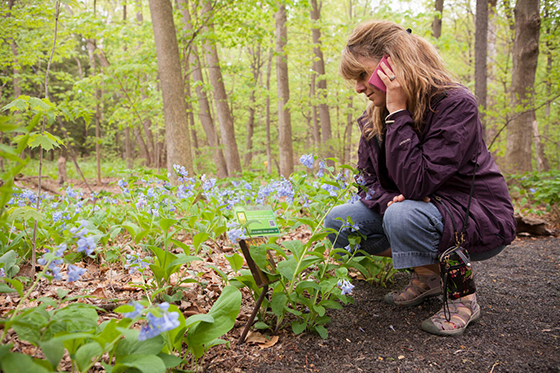
Visitors scan a QR code to access a web-based Garden Guide, which offers 10 self-guided tours throughout the botanic gardens’ on-campus gardens, gorges, and natural areas. In addition, gardens around the Nevin Welcome Center and F.R. Newman Arboretum offer stops with short audio narratives. Visitors access these by dialing numbers on signs at each stop. When users first access either the web-based guide or dial-in narratives, they are prompted to select one of the three available languages.
This multilingual project came to life through collaboration among Cornell Botanic Gardens and two campus partners: the Language Resource Center and the Translator Interpreter Program (TIP). Students working in these programs first translated the existing 26 English language audio narratives, then read and recorded them in Spanish and Mandarin.
Cornell University and Cornell Botanic Gardens welcome thousands of visitors a year, many of whom speak languages other than English. Sarah Fiorello, interpretation coordinator at Cornell Botanic Gardens, recounts times leading tours when she noticed a student translating information to family members who were less fluent in English.
“Cornell Botanic Gardens’ mission is to inspire people to understand, appreciate, and nurture plants and the cultures they sustain,” Fiorello said. “To effectively share with visitors how plants and people are inextricably linked, we need to communicate that knowledge in languages they readily speak.”
The need for expanding self-guided tours to languages other than English was identified as part of the interpretive planning process. With input from Cornell’s Office of Student and Campus Life, Fiorello decided to start with Spanish and Mandarin, the two most spoken languages other than English among students.
Fiorello reached out to the Translator Interpreter Program (TIP), a student organization on campus that trains bilingual students to serve as volunteer translators, where she connected to Matthew Norman-Aritzía ‘25, a student who was a part of TIP’s executive team. Norman-Aritzía saw the multilingual audio tours as a way to open up the gardens to a broader audience and help prospective students envision themselves at Cornell. Throughout the project, he worked as an interpreter and with other interpreters to record the 26 audio narratives included in the tours.
Once the translations were completed, Sam Lupowitz, media manager in charge of IT and AV at the Language Resource Center handled the technical end of recording and coordinated logistics.
“The tours in Spanish and Mandarin are a beautiful resource for the community,” he said. “They take an existing set of tours and make them accessible to many more people.”
Visitors choose from 10 walking tours via the web-based Garden Guide. These highlight the natural history of the surrounding area, share enriching stories of the life within them, and provide information on plants and their significance to human cultures. The walking tours span the gardens around the Nevin Welcome Center, the F.R. Newman Arboretum, Mundy Wildflower Garden, and iconic campus natural areas, such as Beebe Lake and Cascadilla Gorge.
Noah Davis ’28 is communications assistant at Cornell Botanic Gardens.