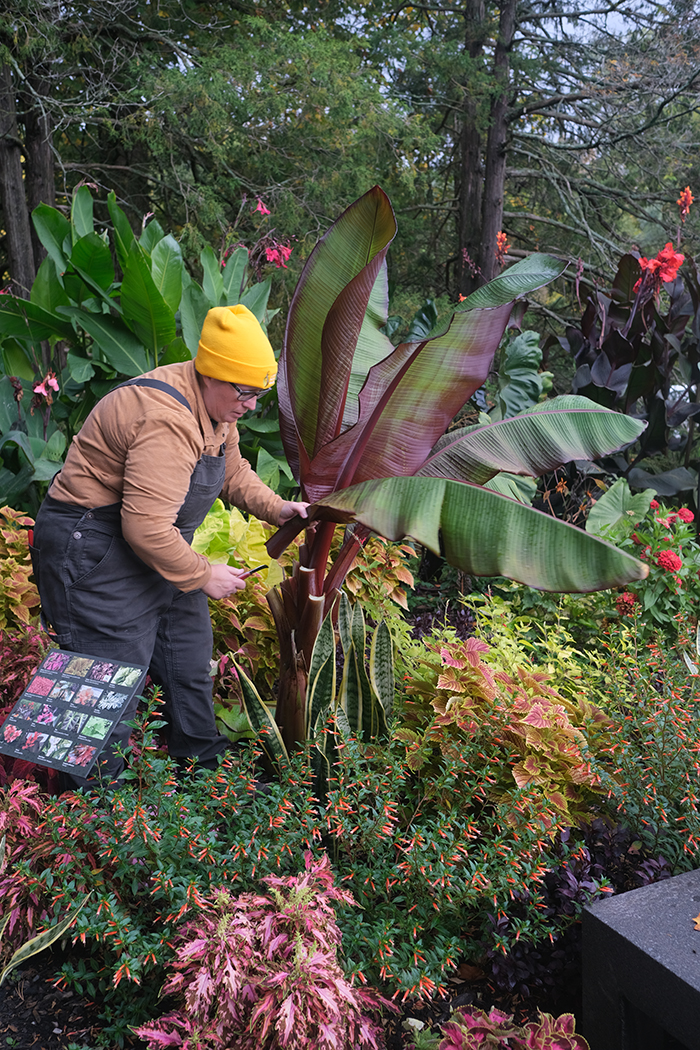
Each summer, tropical plants fill the garden beds around the Nevin Welcome Center. Bold and bright flowers and foliage evoke a sense of the tropics and introduce visitors to the beauty and cultural stories of plants that can’t survive Upstate New York winters. While admired for their beauty, many of these plants sustain people and have shaped cultural identities around the world. These plants and surrounding containers are known as the Class of ’53 Container and Tropical Garden.
Taro, banana, and agave, three plants featured prominently in the tropical collection, are held dear in many cultures, as symbols of family, community, survival, resilience, and even as gifts from the divine.
Taro
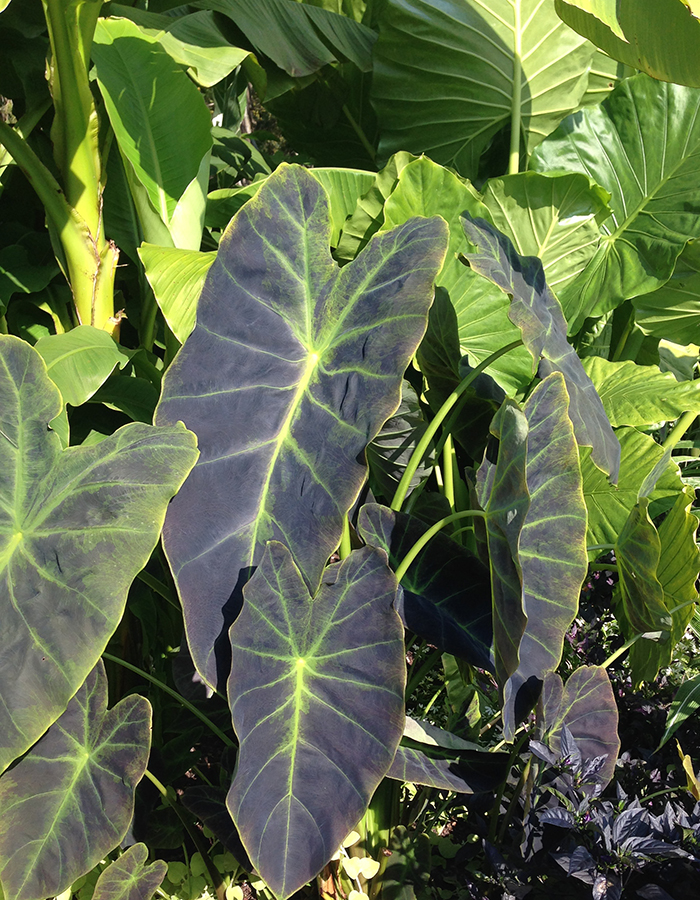
Taro (Colocasia esculenta), also called “elephant’s ear” when it is grown as an ornamental plant, is one of the world’s oldest cultivated food plants and has been an important staple crop for thousands of years. It was first cultivated in the region that spans eastern India, Nepal, and Bangladesh, and spread through cultivation across Asia, the Pacific Islands, Africa, then on to the Caribbean and the Americas through the transatlantic slave trade. Its nutritious corms, leaves, and stems provide a valuable food source, and its ability to grow in both wet and dry conditions make it especially important to many agricultural societies.
Taro remains one of the world's most culturally significant food plants, serving as both a source of nourishment and a powerful symbol of family, heritage, and belonging. In Hawai’i, taro is known as kalo and is central to mythology, family traditions, and cuisine. Hawaiian tradition identifies kalo as an ancestor of the Hawaiian people, symbolizing the connection between humans, nature, and family. This relationship is reflected in the word ʻohana (family), which derives from ʻoha, the young shoots growing from the taro corm. Taro is also featured in traditional foods such as poi, table taro, taro chips, and luau dishes. The term “luau,” now used for Hawaiian feasts, originally referred to the young taro leaves often served at these gatherings.
Abyssinian Banana
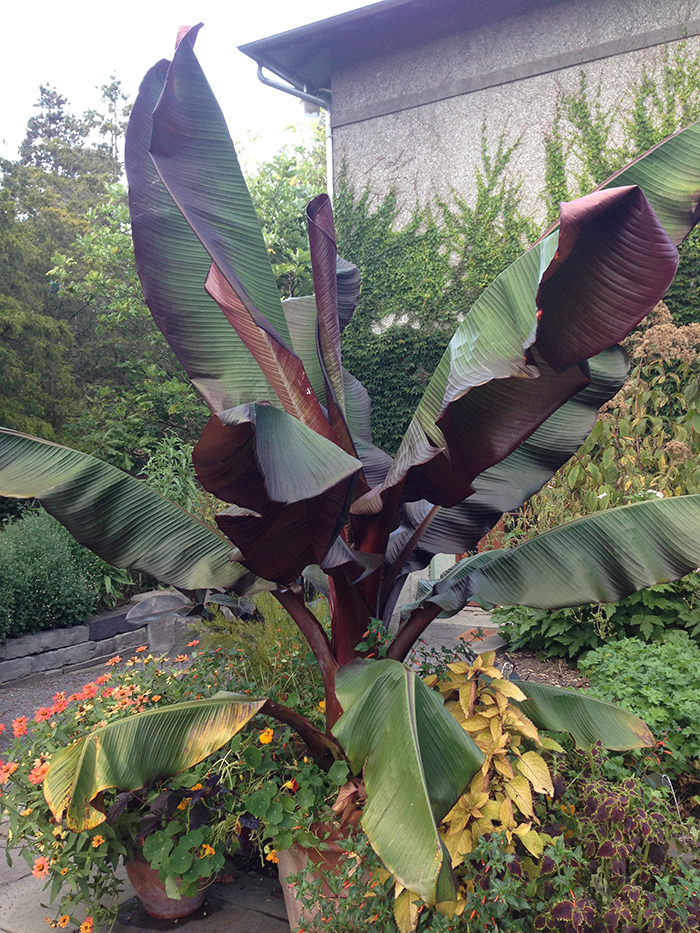
The Abyssinian banana (Ensete ventricosum), is a large, herbaceous plant native to eastern Africa. Although it resembles a banana plant and can grow up to 20 feet tall, its fruit is not edible, earning it the name “false banana.” Instead, it is valued for its starchy corm and pseudostem, making it one of Ethiopia’s most important food crops. The plant provides food in several forms, including kocho, a fermented bread-like staple made from the grated corm and leaf sheaths; bulla, a starchy powder used as a cereal; and amicho, boiled corm pieces prepared like potatoes.
Beyond its role as a food source, Abyssinian banana is deeply integrated into Ethiopian daily life. Its leaves are used as food wrappers, serving plates, and livestock feed, while its fibers are woven into ropes, baskets, and mats. It is also interplanted with young coffee plants to provide shade, supporting another important Ethiopian crop. Often referred to as the “tree against hunger,” this plant symbolizes survival, resilience, and stability because it provides a reliable food source during droughts and periods of scarcity.
Agave
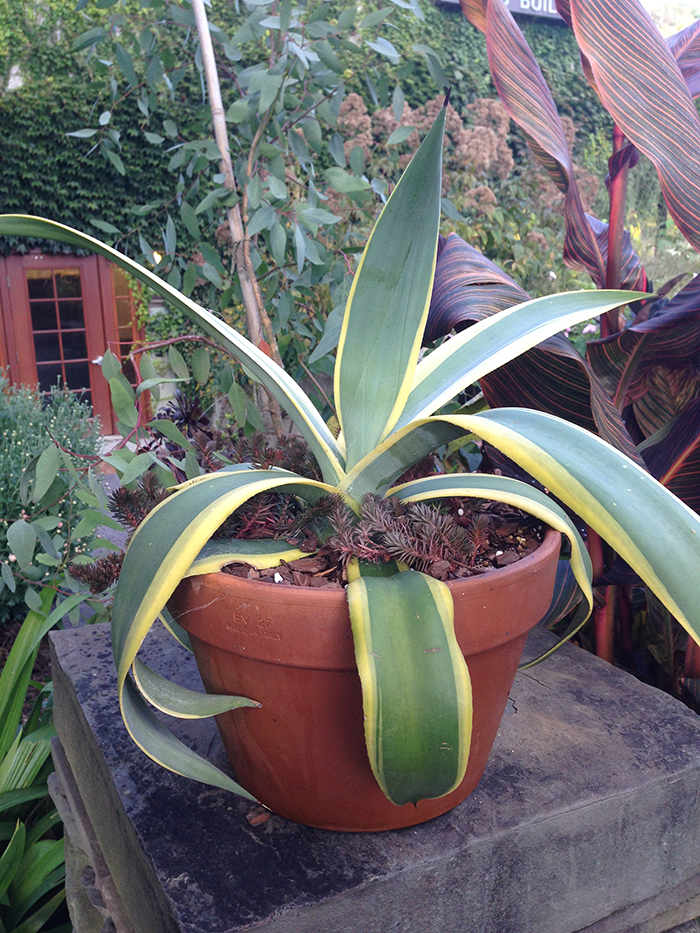
Agave (Agave americana), is a large succulent native to Mexico and the southwestern U. S. Known for its dramatic spiny leaves and towering flower stalk that can reach 30 feet, the plant flowers only once near the end of its life before dying. Beyond its striking appearance, agave has played an important role in the cultures of Mexico for centuries.
Among the Aztecs (Mexica), agave was viewed as a divine gift because it provided food, fiber, medicine, tools, and the sap used to make pulque, a ceremonial fermented drink. Agave sap, known as agua miel or “honey water” can also be made into syrup, vinegar, or sweet agave nectar, which is now popular as a low-glycemic sweetener. Perhaps the most noteworthy use of the Agave is for distilling tequila, which is made from another species, the blue agave (Agave tequilana).
The plant’s strong, fibrous leaves have long been harvested to make rope, cloth, mats, and other useful products. A related agave species (A. sisalana) is used to produce sisal fiber for carpets, bags, twine, and handicrafts, contributing to the plant’s enduring cultural and economic importance.
What happens to these plants during the winter?
After the first sign of frost in mid-October, staff horticulturalists cut back these tender tropical plants, making cuttings from some of the leaves to grow in the greenhouse over the winter months. These new plants will be planted in the tropical garden to make a big colorful splash the following season.