

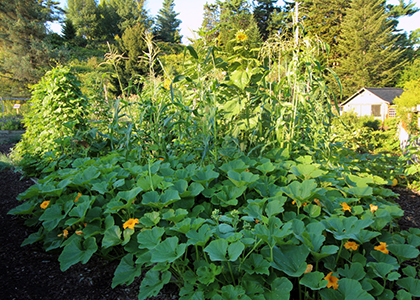
Across Arboretum Road facing the Nevin Welcome Center, tall and mighty stalks of corn grow in the Pounder Vegetable Garden. Flourishing beside the corn are a variety of vegetables and plants including beans, squash, sunflowers, and tobacco.
What do they all have in common? The seeds of these plants have storied histories and futures that reflect the resilience, engagement, and attentiveness of their caretakers—people from the Gayogo̱hó꞉nǫˀ community.
The Gayogo̱hó:nǫˀ are members of the Haudenosaunee Confederacy, an alliance of six sovereign Nations with a historic and contemporary presence on this land. The Confederacy precedes the establishment of Cornell University, New York state, and the United States of America.
In 2021, the Gayogo̱hó꞉nǫˀ Learning Project was founded to revive the Gayogo̱hó꞉nǫˀ language and cultural practices among this community and non-Gayogo̱hó꞉nǫˀ people. The project hosts numerous language courses, workshops, discussion groups and more around Ithaca.
This year, 2025, the Cornell Botanic Gardens started a new collaboration with the Gayogo̱hó꞉nǫˀ Learning Project to plant Gayogo̱hó꞉nǫˀ heritage seeds in their traditional homeland.
Harvested seeds from the plants in the Pounder Vegetable Garden will be shared with Gayogo̱hó꞉nǫˀ living at the Six Nations of the Grand River Reservation in Canada.
This collaboration is just one small part of an ongoing initiative by the Gayogo̱hó꞉nǫˀ Learning Project to foster biocultural connections between the Gayogo̱hó꞉nǫʼand their traditional homelands.
On June 20, 2025, Stephen Henhawk (Gayogo̱hó꞉nǫˀ Knowledge Keeper) and Michelle Seneca (Gayogo̱hó꞉nǫˀ Learning Project outreach and engagement lead) shared several stories of the growing plant’s seeds with members of the Cornell Botanic Gardens’ staff while transplanting them to the garden.
While several of the stories highlighted the journey of the seeds over hundreds of years and where they have been in recent decades, the main focus of these discussions were about the future roles these plants and seeds will play among the Gayogo̱hó꞉nǫˀ People.
Just as these plants sustained the Gayogo̱hó꞉nǫˀ during times of climate, social, and geographic change in the past, the seeds and plants growing here today will support future generations of Gayogo̱hó꞉nǫˀ to build food and language sovereignty in the face of the climate crisis and its uncertainties.
Being a part of this experience has underscored for me the important role universities can play in expanding Native-led initiatives that aim to responsibly steward the environment and cultural revival. Also, by working with the Gayogo̱hó꞉nǫˀ Learning Project on this project, I am reminded of how important thoughtful cross-cultural collaborations are in co-producing solutions to the climate crisis.
Blythe Van Ness '26, Garden Ambassadors Co-Lead